THE HALLICRAFTERS S-40A Shortwave Communications Receiver Power
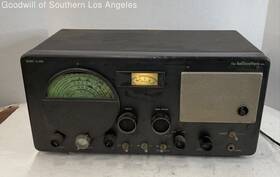
( Brand: The Hallicrafters ), ( Manufacturer Part Number: S-40A ), ( Type: Communications Receiver/shortwave Radio )
Review THE HALLICRAFTERS Vintage Shortwave Communications Receiver Power Tested
The **Hallicrafters S-40A Shortwave Communications Receiver** stands as a legendary piece of analog radio engineering, celebrated for its robust performance, timeless design, and unparalleled versatility in the world of shortwave listening and amateur radio. Introduced in the mid-20th century and later refined into its iconic S-40A variant, this vacuum tube-powered receiver embodies the golden era of radio craftsmanship, offering a blend of simplicity, durability, and exceptional audio fidelity that remains unmatched by modern digital alternatives. Built with a rugged, all-metal chassis and a front-panel layout that balances functionality with intuitive operation, the S-40A is a testament to Hallicrafters commitment to precision and reliability. At its core, this receiver is a **superheterodyne** design, featuring a **five-tube circuit** (including a 6BA6 converter, 6BA6 IF amplifier, 6BA6 detector, 6BA6 audio amplifier, and a 6X4G power tube) that delivers a broad frequency range from **1.5 to 30 MHz**, making it ideal for monitoring international broadcasts, amateur radio (HF bands), shortwave listening (SWL), and even early forms of digital mode experimentation. The S-40A s **direct-reading dial** with a calibrated scale ensures accurate tuning, while its **adjustable bandwidth control** allows operators to fine-tune reception for crystal-clear signals, whether in broad daylight or under the cover of night. One of its most distinctive features is the **built-in power amplifier**, which can drive a modest speaker or headphones with warm, dynamic audio, thanks to its **6X4G power tube** a hallmark of Hallicrafters emphasis on high-quality sound reproduction. The receiver s **regenerative circuit** further enhances sensitivity, enabling listeners to pull in faint signals that might otherwise be lost to static or interference. Beyond its technical prowess, the S-40A carries a nostalgic charm, with its **retro styling**, including a **front-panel meter** for signal strength monitoring and a **rotary tuning knob** that evokes the tactile satisfaction of analog radio operation. Whether used by hobbyists, collectors, or dedicated shortwave enthusiasts, the S-40A is more than just a receiver it is a piece of radio history that continues to captivate with its blend of performance, craftsmanship, and enduring appeal. For those seeking an authentic, analog listening experience, the Hallicrafters S-40A remains a benchmark in shortwave communications, offering a window into the past while delivering present-day enjoyment.
The **Hallicrafters S-40A** is a classic shortwave communications receiver from the mid-20th century, known for its durability and analog performance. Below is a detailed breakdown of its pros and cons, followed by a conclusion and recommendation.
---
### **Pros of the Hallicrafters S-40A**
1. **Reliability and Durability**
The S-40A is built with robust components, including a vacuum tube circuit (primarily 12AX7, 12AT7, and 6BA6 tubes) that were designed for longevity. Many units from the 1950s 1960s era remain fully functional today with proper maintenance. The chassis is heavy-duty, and the construction avoids fragile modern components.
2. **Analog Clarity and Warm Sound**
As an analog receiver, the S-40A produces a distinct, slightly warmer audio tone compared to modern digital receivers. This can be appealing for listeners who prefer the "vintage" sound of tube-based electronics. The lack of digital processing also means fewer artifacts or latency issues.
3. **Wide Frequency Range and Manual Tuning**
The S-40A covers **530 kHz to 30 MHz** (with optional extensions to 29.9 MHz), making it suitable for shortwave broadcasting, amateur radio (with modifications), and even some HF military/commercial bands. The manual tuning dials (with calibrated markings) provide a tactile, hands-on experience that digital receivers lack.
4. **Modular and Upgradable**
The S-40A was designed with modularity in mind. Many components (e.g., IF stages, power supply) can be replaced or upgraded. There is a strong community of enthusiasts who create aftermarket parts, such as improved power supplies, better tubes, or even full rebuilds. This makes it easier to extend its lifespan or enhance performance.
5. **Low Power Consumption**
Unlike modern receivers with high-power digital circuits, the S-40A runs on relatively low power (typically **115V AC, 50 100W**), making it suitable for portable setups with appropriate power adapters.
6. **Educational Value**
For those interested in electronics or radio history, the S-40A offers a tangible example of mid-century engineering. It teaches principles of vacuum tube operation, RF amplification, and analog signal processing, which can be valuable for hobbyists or students.
7. **Resale Value and Collectibility**
Well-preserved S-40As are sought after by collectors, especially in "as-is" or restored condition. This means that even if you decide to sell it later, you may recover a significant portion of your investment.
8. **No Digital Glitches**
Unlike modern receivers with software-defined radio (SDR) or digital signal processing (DSP), the S-40A is free from firmware updates, buffering issues, or compatibility problems with new technologies.
---
### **Cons of the Hallicrafters S-40A**
1. **Maintenance Requirements**
The S-40A relies on **vacuum tubes**, which degrade over time and require periodic replacement (typically every **1,000 5,000 hours** of use). Tubes can fail unexpectedly, and sourcing replacements may be difficult or expensive. Additionally, the receiver lacks a built-in tube tester, making troubleshooting harder for beginners.
2. **Limited Sensitivity and Selectivity**
Compared to modern receivers, the S-40A has **lower sensitivity** (weaker signal detection) and **poor selectivity** (adjacent station interference is more likely). Its **superheterodyne design** from the 1950s is not optimized for the high-density spectrum of today s shortwave bands. This can make weak signals harder to pick up, especially in noisy environments.
3. **No Built-in Noise Blanking or Automatic Gain Control (AGC)**
Modern receivers often include features like **noise blanking** (to reduce static) and **AGC** (to stabilize signal levels). The S-40A lacks these, meaning weak signals may be drowned out by noise, and strong signals can distort the audio.
4. **No Digital Features**
The S-40A has **no memory presets, scanning, or digital tuning**. Tuning manually to specific frequencies (e.g., 9.5 MHz for BBC) requires patience and familiarity with the dials. There is also no built-in **RIT (Receiver Incremental Tuning)** or **XIT (Transmitter Incremental Tuning)**, which are useful for amateur radio operators.
5. **Power Supply Limitations**
The original power supply may not be efficient or safe for modern use. Many owners replace it with a **modern linear power supply** or a **switching power supply** (though the latter requires careful design to avoid RF interference). Poor power supply choices can lead to **hum, instability, or even damage to the receiver**.
6. **No USB or Computer Interface**
Unlike modern SDR receivers (e.g., SDRplay, RTL-SDR), the S-40A cannot be connected to a computer for software-defined radio (SDR) applications. This limits its use for digital modes (e.g., PSK31, CW decoding) or spectrum analysis.
7. **Physical Size and Portability**
The S-40A is a **large, heavy unit** (weighing ** 20 25 lbs or 9 11 kg**), making it impractical for field use or travel. Its size also means it requires a dedicated space in a shack or on a desk.
8. **Learning Curve for Beginners**
Operating an analog receiver requires **patience and practice**. Beginners may struggle with:- **Manual tuning** (no digital readouts).
- **Tuning in weak signals** (lack of AGC/noise blanking).
- **Troubleshooting tube-related issues** (e.g., misaligned IF, weak audio).
- **Understanding vintage radio terminology** (e.g., "IF shift," "RF gain").
9. **Potential for Misalignment**
Over time, the **IF (Intermediate Frequency) alignment** of the S-40A can drift, leading to poor reception. Realignment requires specialized equipment (e.g., a signal generator) and technical skill, which may be beyond the capability of casual users.
10. **Ethical and Legal Considerations**
- **Amateur Radio Use:** The S-40A is not **FCC-certified** for amateur radio use in the U.S. (or equivalent in other countries). Modifying it for ham radio operation may require additional compliance steps, such as **re-alignment for specific bands** or **FCC Part 97 compliance**.
- **Military/Restricted Bands:** Some frequencies (e.g., military or government bands) may be **illegal to monitor** without proper licensing. The S-40A s wide range does not exempt the user from legal restrictions.
---
### **Conclusion**
The **Hallicrafters S-40A** is a **fantastic choice** for:- **Enthusiasts who appreciate analog radio and vintage electronics.**
- **Listeners who enjoy the challenge of manual tuning and tube-based operation.**
- **Collectors or those interested in radio history.**
- **Amateur radio operators** (with modifications and compliance considerations).
- **Budget-conscious buyers** who prioritize durability over modern features.
However, it is **not ideal** for:- **Casual listeners** who want **plug-and-play, digital tuning, and noise reduction.**
- **Users who prioritize sensitivity, selectivity, and weak-signal reception.**
- **Those who need portability or computer integration (SDR).**
- **Beginners** who lack patience for troubleshooting or maintenance.
---
### **Recommendation**
**Buy the Hallicrafters S-40A if:**You are **passionate about analog radio** and enjoy the tactile experience of tuning.
You are **willing to invest time in maintenance** (tube replacements, power supply upgrades).
You **appreciate vintage aesthetics** and the educational value of a mid-century receiver.
You plan to **modify it for amateur radio** (with proper alignment and compliance).
You find it **affordable** compared to modern receivers (used units can be found for **$200 $600**, while restored or upgraded versions may cost more).
**Avoid the S-40A if:**You want **modern digital features** (SDR, memory presets, noise blanking).
You **hate maintenance** (tube replacements, alignment, power supply issues).
You need **portability or weak-signal performance**.
You are **new to shortwave listening** and prefer an easier-to-use receiver.
#### **Alternatives to Consider:**- **For modern digital receivers:** **ICOM IC-R8600, Kenwood TRD-5H, or a budget SDR (e.g., SDRplay RSP1A).**
- **For analog but more modern:** **Hallicrafters SX-130 (if available) or a vintage **National HW-100** (though less common).**
- **For amateur radio:** **Yaesu FT-298, Icom IC-7300, or a **QRP (low-power) rig** like the **Elecraft K
Details:
Condition: Fair - shows sign of wear. Model: S-40A. Functionality: Item powers on - no further testing Only turned the device. Vintage The Hallicrafters S-40A Shortwave Communications Receiver Power Tested: Brand.
part #: s40a prices
- $125.00-$253.74
specifications theatereceiv:
- brand: The Hallicrafters
- mpn: S-40a
- type: Communications Receiver/shortwave Radio
offer theatereceiv:
- quantity: 1
- availability: In Stock
- started: March 2, 2026
- options: Ship-to-home
- sold: 0
payments theatereceiv:
- other
- credit card: Mastercard
- wallet: Paypal
seller theatereceiv:
- city: Long Beach, California
- rating: 99.1%
- # reviews: 5157
returns theatereceiv:
- policy: No Returns
general theatereceiv:
- Home Audio > Receivers Amplifiers > Receivers
- condition: Used
shipping theatereceiv:
- transit: 4-10 Days
- type: Calculated
- cost: $0.00
- class: Standard
- service: FedEx Ground / FedEx Home Delivery
- carrier: FedEx
The Hallicrafters S-40A Is Similar To:
- S-38d Vintage Hallicrafters Model Shortwave Receiver Worldwide (57.1% similar) Best way to ship to AK or hi is USPS please. I strive to achieve 5 star service. If you are not certain, ask questions. I will not alter values or list as I m easy to contact. Be certain you can afford an item before you make a bid or offer. Also check my other listings for more neat vintage used ...(October 19th, 2016)