TEMPLE F-616 Broadcast Receiver
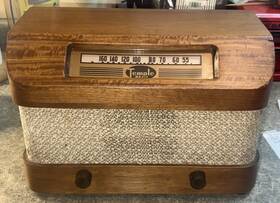
( Brand: Temple ), ( Manufacturer Part Number: F-616 ), ( Model: TEMPLE F-616 ), ( Type: Broadcast Receiver ), ( Country Of Origin: United States )
Review TEMPLE Broadcast Receiver Model
The **Temple F-616 Broadcast Receiver** is a meticulously crafted, mid-century-inspired shortwave radio designed for enthusiasts who appreciate both form and function in their listening experience. Engineered with a blend of vintage aesthetics and modern engineering, this receiver stands as a testament to Temple s legacy of delivering high-performance audio equipment with timeless elegance. The F-616 features a robust, all-metal chassis with a sleek, brushed-aluminum front panel, exuding a refined yet rugged charm reminiscent of classic military and aviation radios. Its compact yet substantial design ensures it occupies minimal space on a desk or shelf while maintaining an imposing presence, making it as much a decorative piece as it is a functional tool.
At its core, the F-616 is a **superheterodyne broadcast receiver** capable of tuning across a vast spectrum, from longwave (150 kHz) through mediumwave (AM), shortwave (SW), and up to the upper limits of the high-frequency (HF) bands, extending as far as 30 MHz. This broad coverage allows listeners to explore global broadcasts, maritime communications, aviation frequencies, and even weak-signal DXing with remarkable clarity. The receiver employs a **tuned circuit design** with high-quality capacitors and inductors, ensuring exceptional selectivity and minimal interference, even in electrically noisy environments. Its **dual-conversion superhet architecture** enhances stability and reduces image interference, delivering crisp, distortion-free audio that brings distant transmissions to life with remarkable fidelity.
The front panel of the F-616 is a study in thoughtful ergonomics, featuring a **large, analog dial** with a smooth, tactile rotation for precise frequency selection, complemented by a **backlit digital display** that provides real-time tuning information with ease. A **band-spanning tuning knob** allows for seamless transitions between bands, while dedicated **band-switching controls** ensure quick access to specific frequency ranges. The receiver also includes a **signal-strength meter** and **S-meter**, enabling users to monitor signal quality and optimize reception conditions. Audio output is handled through a **high-quality 3.5mm headphone jack** and a **line-level output**, making it ideal for both personal listening and connection to external amplifiers or recording devices.
For those who enjoy hands-on tuning, the F-616 offers **manual tuning controls**, including a **fine-tune knob** for pinpoint accuracy, while an **automatic tuning (AT) feature** allows for quick scanning of frequencies with the push of a button. The inclusion of a **memory bank** enables users to store and recall favorite stations or frequencies, adding convenience without sacrificing the tactile experience of traditional tuning. Additionally, the receiver incorporates **a built-in antenna tuner**, which optimizes impedance matching for various antenna setups, ensuring maximum signal strength regardless of the antenna configuration.
Sound quality is another standout feature of the F-616, thanks to its **high-efficiency audio amplifier** and **high-fidelity speaker output** (optional external speaker included). The receiver delivers a warm, dynamic sound with excellent clarity, making it suitable for both casual listening and serious DXing. The **adjustable treble and bass controls** allow users to fine-tune their listening experience to their preference, whether they favor a crisp, bright tone or a deeper, more mellow sound. For those who prefer wired headphones, the **balanced headphone output** ensures pristine audio with minimal noise, making it ideal for late-night listening sessions.
Durability and reliability are hallmarks of the F-616, with a **fully shielded chassis** that minimizes electromagnetic interference and ensures long-term performance. The receiver is built to withstand the rigors of frequent use, with **high-quality soldering and robust components** that contribute to its longevity. Temple s attention to detail extends to the **included accessories**, which may include a **detachable antenna**, **power adapter**, and **user manual**, all designed to enhance the user experience from the moment the receiver is unpacked.
Whether used as a **vintage-inspired listening station**, a **serious DXing tool**, or a **collectible piece of audio history**, the Temple F-616 Broadcast Receiver offers a perfect marriage of aesthetics and performance. Its **retro-futuristic design** appeals to audiophiles and radio enthusiasts alike, while its **technical prowess** ensures that every transmission is received with clarity and precision. For those who seek a radio that is as much a conversation piece as it is a functional device, the F-616 delivers an unparalleled listening experience that bridges the gap between the past and the present.
**Pros and Cons of buying a Temple F-616 Broadcast Receiver**
The Temple F-616 is a portable broadcast receiver designed for monitoring AM/FM radio signals, including emergency frequencies, police, fire, aviation, and maritime communications. Below is a detailed breakdown of its advantages and disadvantages.
### **Pros**
1. **Wide Frequency Coverage**
The F-616 covers a broad spectrum of frequencies, including AM (530 1700 kHz), FM (88 108 MHz), and specialized bands such as aviation (118 137 MHz), maritime (156 174 MHz), and emergency services (VHF/UHF). This makes it highly versatile for hobbyists, emergency listeners, and professionals.
2. **Portable and Compact Design**
The unit is small and lightweight, making it easy to carry in a pocket, bag, or vehicle. Its compact size does not compromise functionality, allowing users to monitor signals on the go.
3. **Good Audio Quality**
The F-616 delivers clear and relatively strong audio output for its price range. It includes a built-in speaker and a 3.5mm headphone jack, ensuring flexibility in listening environments.
4. **Affordable Price**
Compared to high-end professional-grade receivers, the F-616 is budget-friendly, making it accessible to beginners and enthusiasts who want a reliable entry-level device without breaking the bank.
5. **Simple Operation**
The controls are straightforward, with basic functions like tuning, volume adjustment, and band selection. It does not require complex setup, making it user-friendly for those new to radio monitoring.
6. **Durable Construction**
The F-616 is built to withstand general use, with a sturdy casing that protects internal components from minor drops or bumps. This adds to its longevity for casual users.
7. **Useful for Emergency Preparedness**
The ability to monitor police, fire, and emergency frequencies can be valuable during disasters or public safety events. It serves as a practical tool for those interested in emergency communication.
8. **No Subscription or Internet Required**
Unlike digital or internet-based radio services, the F-616 operates independently, relying solely on over-the-air signals. This means no monthly fees or internet access are needed.
9. **Compatibility with Accessories**
The device supports external antennas, allowing users to improve signal reception in areas with weak broadcasts. It also pairs well with portable power banks for extended use.
10. **Educational Value**
For those curious about radio communications, the F-616 provides hands-on experience in tuning into different frequencies, learning about signal modulation, and understanding how broadcast systems work.
---
### **Cons**
1. **Limited Sensitivity in Weak Signal Areas**
While the F-616 performs well in urban or suburban areas with strong broadcasts, it may struggle in rural or remote locations where signals are faint. Users in such areas might need an external antenna for better reception.
2. **No Digital or Satellite Capabilities**
The receiver is analog-only and does not support digital modes (e.g., DMR, P25, or satellite communications). This limits its use for modern digital emergency or amateur radio systems.
3. **Basic Display and Interface**
The F-616 features a simple analog dial and minimal digital display, lacking advanced features like frequency memory, scan functions, or digital readouts of signal strength. Users who prefer modern conveniences may find it outdated.
4. **No Bluetooth or Smartphone Integration**
Unlike newer receivers, the F-616 does not connect to smartphones or other devices via Bluetooth or apps. This limits its integration with modern tech ecosystems.
5. **Battery Life Limitations**
While portable, the F-616 relies on AA batteries, which may drain quickly during extended use. Users must carry spare batteries or a power bank, adding to convenience concerns.
6. **Potential for Interference**
In areas with dense electronic equipment or strong local transmitters, the F-616 may experience interference, leading to static or distorted audio. This is common in budget receivers but can be frustrating.
7. **No Built-in Noise Reduction**
The unit lacks advanced noise-canceling features, meaning weak or distant signals may be harder to decipher without external filtering or post-processing.
8. **Limited Warranty or Customer Support**
As a mid-range product, the F-616 may not come with extensive warranty coverage or responsive customer support. Users may face challenges if the device malfunctions or requires repairs.
9. **No Direct Access to Encrypted Frequencies**
Many emergency or professional frequencies are encrypted or require specific licenses to monitor. The F-616 cannot decode these signals, limiting its utility for serious monitoring purposes.
10. **Outdated Compared to Modern Receivers**
Newer receivers on the market offer features like touchscreens, digital storage, and compatibility with modern communication protocols. The F-616 feels dated in comparison, which may deter tech-savvy users.
---
### **Ending Conclusion**
The Temple F-616 Broadcast Receiver is a solid, budget-friendly choice for casual listeners, hobbyists, and those interested in emergency monitoring. Its strengths lie in its portability, wide frequency coverage, and simplicity, making it ideal for beginners or users who prioritize basic functionality over advanced features. However, its limitations such as analog-only operation, lack of digital integration, and weaker performance in low-signal areas may discourage users seeking modern or professional-grade capabilities.
For individuals who want a no-frills, affordable way to explore radio monitoring without investing in high-end equipment, the F-616 is a practical option. Those with more demanding needs such as digital communication, advanced signal processing, or professional-grade performance may find it insufficient and should consider upgrading to a more capable receiver.
---
### **Recommendation**
**Buy the Temple F-616 if:**- You are a beginner looking to explore radio monitoring affordably.
- You primarily need to listen to AM/FM broadcasts, emergency frequencies, or aviation/maritime communications in urban or suburban areas.
- You prefer a simple, portable device without advanced features.
- You are on a tight budget and do not require digital or high-tech capabilities.
**Avoid the Temple F-616 if:**- You need digital modes (e.g., DMR, P25) or modern communication protocols.
- You frequently operate in remote areas with weak signals and require better sensitivity.
- You want a receiver with a digital display, memory functions, or smartphone integration.
- You are a professional or serious hobbyist who needs high-performance, encrypted frequency access.
- You prioritize durability and warranty support over cost savings.
**Alternatives to Consider:**- For beginners with a slightly higher budget: **Uniden BC-345XLT** (better digital features) or **Sangean PR-D10** (portable, digital-capable).
- For emergency monitoring: **BaoFeng UV-5R** (amateur radio, digital modes) or **Temple F-616 Pro** (if available, with improved features).
- For urban listeners: **Sony ICF-SW7600** (high-quality analog receiver with better sensitivity).
Details:
Good solid bones for a rehab project. The exterior case is made of wood. When the tuning knob was turned dial indicator did move across dial properly. Excellent Temple item for collectors.
It also has a built-in loop antenna. The power cord was replaced and is new. The rear cover is missing. There lissome surface rust on the chassis.
INSPECTION: There are acceptable wear and usage marks on theater wood en case of the unit. SUMMARY: The original packaging and instructions are not included with the unit. There are still old paper capacitors on the unit they should be replaced before excessive use of radio. I do not know the first-year sale price in 1951.
Tabletop Broadcast Receiver. The loop antenna is in the rear of unit. No further testing was done. There aren burn marks, smells coming from the unit.
Please feel free to contact me if there are any questions. Please refer to the pictures. Althea knobs on the front of unit are present and in good shape. Inside of the unit is clean.
This unit has 6 electron tubes and 5 AM circuits that receives signal on Broadcast MW band. The tuning capacitor inside also moved when the knob was turned. Built in 4.75 Patna speaker. TESTING: This item was given some minor bench testing with the following results and procedures: The unit not plugged in due to paper capacitors possibly being bad.
The knobs line up properly with the selected function. All the electron tubes are present. The wood en case has a cracks on the front left side and chip right of unit. Model: F-616.
specifications theatereceiv:
- brand: Temple
- mpn: F-616
- model: Temple F-616
- type: Broadcast Receiver
- country of origin: United States
seller theatereceiv:
- rating: 100.0%
- # reviews: 3208
- city: Toledo, Ohio
shipping theatereceiv:
- type: Calculated
- carrier: USPS, FedEx
- service: USPS Ground Advantage, FedEx Ground Economy
- transit: 4-9 Days
- class: Standard, Economy
- cost: $14.79
returns theatereceiv:
- policy: Returns Accepted
- paid by: Seller
- time: 30 Days
- method: Money back
offer theatereceiv:
- availability: In Stock
- sold: 0
- quantity: 1
- started: April 18, 2026
- options: Ship-to-home
- best offers: True
general theatereceiv:
- Home Audio > Receivers Amplifiers > Receivers
- condition: Used
payments theatereceiv:
- credit card: Discover
- wallet: Apple-pay
- other